Recipe · Indirect · Advanced
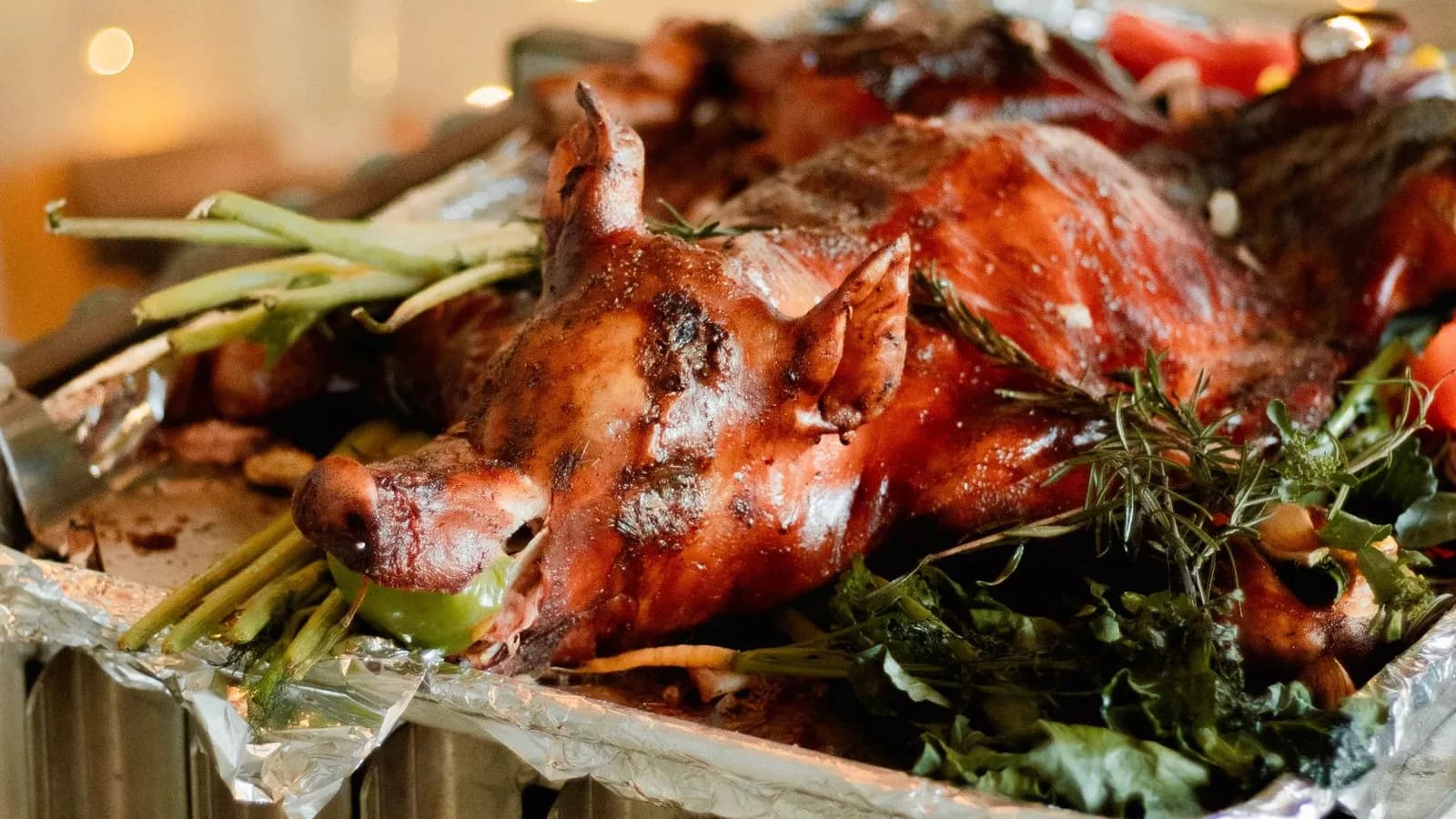
Suckling pig (cochinillo) roasted in a kamado, by the quarter, with crackling skin
This is the Christmas roast done in a kamado, with the truth up front: a whole one will not fit. Two quarters, indirect at 150 °C with water under the meat, then a 250 °C finish so the skin blisters and crackles.
Quick answer
Air-dry the skin of two suckling pig quarters in the fridge for 12-24 hours, prick it only on the surface and rub with lard. Roast skin up, indirect at 150 °C, with water trays over the deflector, for 2-2.5 hours to 85-88 °C in the leg (never below 75 °C). Raise to 250 °C for 20-30 minutes, burping the lid. Cut with shears.
One big step at a time, screen kept on and built-in timers.
- Prep
- 30 min
- Cook
- 210 min
- Servings
- 4 servings
- Temperature
- 150 °C
What time do you want to eat?
Pick a time and we'll tell you when to start.
09:00
Start the prep
09:30
Light the kamado
10:00
Onto the kamado
13:30
Take it off and rest
14:00
Serve
Estimate: it includes lighting and settling the kamado plus a margin for large cuts. If the recipe asks you to marinate or salt ahead, add that time.
Fire setupIndirect
- Dome
- 150 °C
- Deflector
- Yes
- Grate
- Standard height
- Fuel
- Marabú charcoal, firebox filled to the rim
- Setup
- Drip pans with water and bay leaves on the deflector
Temperature curve
4:05 h from lighting
Kamado domeInside the meat (probe)
| # | From | Phase | Dome | Internal |
|---|---|---|---|---|
| 1 | 0:00 | Light the charcoalFull firebox, deflector, trays with water and bay | 20 → 150 °C | no probe |
| 2 | 0:30 | Put the food inQuarters skin up, probe in the thickest part of the leg | 150 → 140 °C | 8 °C |
| 3 | 0:35 | CookLeg at 85-88 °C and shoulder not below 75 °C | 140 → 150 °C | 8 → 86 °C |
| 4 | 3:10 | Raise the heatRefill trays, vents open, hold at 250 °C | 150 → 250 °C | 86 → 87 °C |
| 5 | 3:25 | Sear20-30 min at 250 °C; check the skin at 15 | 242 → 250 °C | 87 → 88 °C |
| 6 | 3:55 | RestSkin up and uncovered | 250 → 80 °C | 88 °C |
| 7 | 4:05 | Serve | off | no probe |
0:00 is the moment you light the charcoal. Internal temperatures are the ones the recipe gives; without a probe, go by the times. Turn these times into clock times with the planner
For this recipe
Ingredients
- suckling pig quarters (cochinillo), one front and one rear (half an animal, about 2.4 kg in total)2
- coarse salt25 g
- lard (manteca de cerdo), at room temperature40 g
- water for the pans (and a little more for topping up)600 ml
- bay leaves3
- cos lettuce (lechuga romana), for the salad1
- spring onion (cebolleta), in thin rings1
- extra virgin olive oil3 tbsp
- white wine vinegar1 tbsp
Another cut
Got a different cut? Here is how the recipe changes
For 4 people the recipe uses 2.3 kg of suckling pig: indirect at 150 °C, 3 h 15 min plus 20 min rest. If the shop had something else:
- Pork knuckle (hock, bone-in and skin-on)Buy 2.2 kg (2 pieces)
- Fire
- Indirect · 150 °C
- Time
- 3 h 10 min
- Rest
- 15 min
Light 10 min later
Same dome, crisp skin in single portions. Indirect at 150 °C, skin up; pull at 85-92 °C in the centre, when the meat gives way to the probe. Rest it unwrapped.
- Pork shoulder (pulled pork)Buy 1.5 kg
- Fire
- Smoked · 120 °C
- Time
- 6 h
- Rest
- 30 min
Light 3 h 40 min earlier
A different dish: no skin to crackle, so you get pulled pork. Drop the dome to 120 °C with smoke and take the centre to 91-93 °C; rest it in foil and pull it.
- Lamb shoulder (bone-in)Buy 2.6 kg (2 pieces)
- Fire
- Indirect · 160 °C
- Time
- 1 h 5 min
- Rest
- 20 min
Light 2 h 30 min later
Lamb, pink and no skin to crisp. Indirect at 160 °C; pull at 57 °C in the thickest part and let it reach 63 °C while resting.
Times are a guide, based on the How much to buy figures; follow the recipe first. Full fire plan for 4 people: Pork knuckle (hock, bone-in and skin-on), Pork shoulder (pulled pork), Lamb shoulder (bone-in).
Allergens
- Sulphites
Based on the recipe's ingredients. Always check the label of every product you buy.
The gear for this recipe
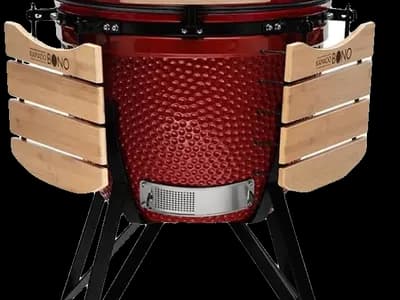
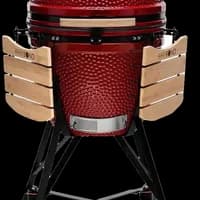 Kamado Bono Grande XXL 59 cmThis recipe depends on space on the grate, which is why it asks for a large kamado. The Kamado Bono Grande XXL measures 59 cm across the body and, according to retailer listings, around 49-50 cm of usable grate: just enough for two suckling pig quarters laid head to tail, with no skin touching the ceramic at the edge. It comes with a ceramic deflector as standard, which is the basis of the indirect roast at 150 °C and the support for the water pans, so nothing else needs buying to set it up. Its ceramic mass takes longer to heat, 30-40 minutes to stabilise, but it then holds the temperature through the two and a half hours of roasting with very little adjustment of the vents.
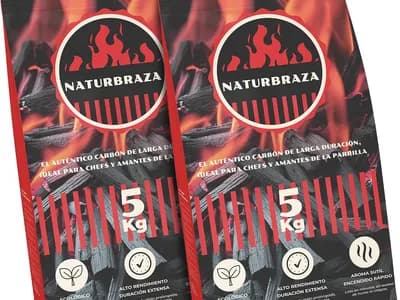
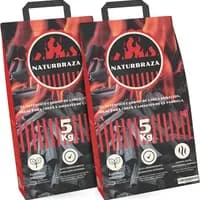 NaturBraza marabu charcoal, pack of two 5 kg bags (10 kg)Between the slow roast and the finish, this suckling pig asks for more than three hours of burn and a final rise to 250 °C without reloading halfway. NaturBraza marabú charcoal is very dense wood: it burns slowly, with a short flame and little ash, the profile that sustains a long cook with the vents almost closed and still has reserve when you open them to go up to 250 °C without reloading. That is why the firebox is loaded to the brim from the start: reloading mid-roast would mean lifting out the grate with the quarters on it.
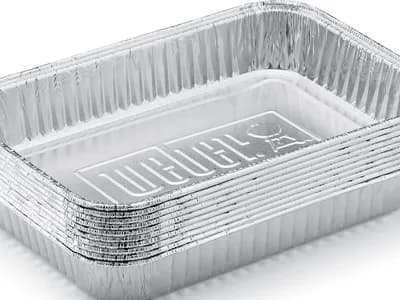
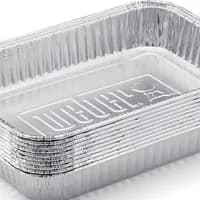 Weber 6415 — small aluminium drip pans, 22 × 15 cm, pack of 10They are the Segovian oven moved into the kamado. The Weber drip pans measure 22 × 15 cm, so two or three fit on the Bono's deflector under the two quarters. With a centimetre of water they do two jobs: they keep the chamber moist during the roast at 150 °C, like the shallow water in the earthenware dish, and they catch the fat the skin releases. While they still hold water, the base stays at around 100 °C and that fat does not scorch or send acrid smoke to the meat, even in the 250 °C finish. As disposable aluminium, they are thrown away at the end and the deflector stays free of carbonised fat. They are thin: lift them cold and full, resting on something rigid.
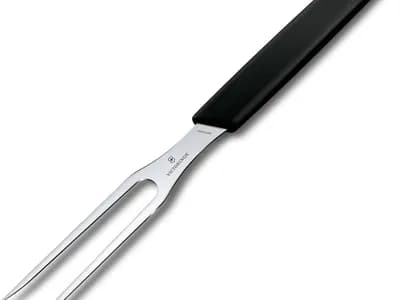
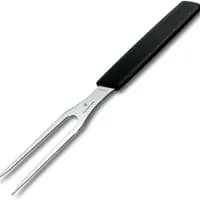 Victorinox Swiss Classic 5.2103.15B: carving fork, 15 cm bladeIt works twice in this recipe, always outside the kamado. Before roasting, the tip of the Victorinox Swiss Classic carving fork pricks the skin on the surface, which is the gesture of the Segovian recipe: about a dozen angled pricks per quarter, without reaching the meat, so the fat underneath has an exit and the skin blisters instead of puffing into pockets. At the end, with the roast rested on the board, it holds each quarter while the shears cut the portions, so the hand does not press the crisp skin. It has a 15 cm forged blade and a plastic handle, so it stays away from the embers: its place is the board.
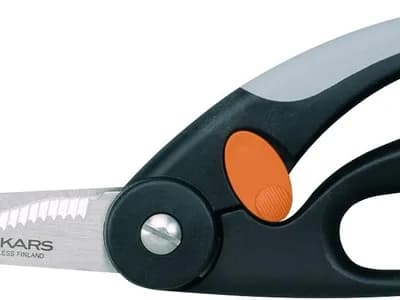
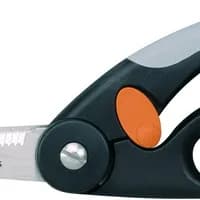 Fiskars Functional Form 1003033: 25 cm poultry shearsThe Fiskars poultry shears are designed for chicken and turkey, and here they work for the same reason: the bones of a milk-fed animal are thin and soft, about the calibre of a large bird's. Their 9.5 cm serrated blade goes through the toasted skin and the ribs of the suckling pig in one clean cut, with the piece skin up, without the downward pressure of a knife that crushes the crust that took so much effort to achieve. With two quarters, regular portions come out without changing tools. To split the backbone of half an animal raw, though, the butcher's saw is the better tool, and these short blades would need several passes.
Method
- 01
Dry the skin the day before
Pat both quarters dry with kitchen paper, the skin above all. Spread the coarse salt over the inner side and rub a thin layer onto the skin. Place them skin up on a rack set over a dish and leave them uncovered on the bottom shelf of the fridge, away from anything that will be eaten uncooked, for 12 to 24 hours: the cold air dries the skin, and dry skin is what blisters later instead of turning leathery. Take them out 45 minutes before roasting.
- 02
Light the charcoal and set up indirect
Empty the ash and fill the firebox to the brim with the NaturBraza marabú charcoal: reloading with the meat inside means lifting out grate, quarters and deflector. Light in one or two spots and leave the lid open for 10 minutes. Fit the Bono's ceramic deflector and, on top, two or three Weber pans, as many as fit without overhanging the deflector, with a centimetre of water and the bay leaves. Set the grate, close up and stabilise at 150 °C at grate height: allow 30-40 minutes.
- 03
Prick and rub
With the tip of the Victorinox carving fork, prick the skin about a dozen times per quarter, at an angle and without reaching the meat: you want an exit for the fat underneath, not for the juices. Blot away any moisture that has appeared. Rub the whole skin with the lard in a thin layer, without forgetting the edges and the trotters, which are the first parts to brown.
- 04
Roast at 150 °C
Set the quarters skin up, head to tail: the leg of one next to the shoulder of the other, clear of the ceramic. Push the probe into the thickest part of the leg, away from the bone, and hold 150 °C for 2 to 2.5 hours. After 45 minutes, burp the lid and top up the pans that still hold water with hot water, slowly and at the edge, from a spouted jug through a gap in the grate. If one is dry and holds fat, add no water: it spits.
- 05
Check doneness
The leg decides. The slow phase ends when it reads 85-88 °C in its thick part and the shoulder does not drop below 75 °C at any point: check by inserting the probe in two or three places, always away from the bone. The physical sign agrees: the leg bone turns with a tug and the meat gives way between the ribs. If the leg stalls at 80 °C, give it another 15-20 minutes; this roast forgives extra time better than haste.
- 06
Finish the skin at 250 °C
Before raising the heat, top up to a centimetre, slowly and at the edge, the pans that still hold water. Open both vents fully and, past 235 °C, close the bottom vent halfway: the ceramic keeps climbing by inertia and settles at 250 °C. Count 20-30 minutes from 250 °C. After 15, burp the lid, with gloves on and your face turned away; check the skin and close again. If an edge darkens, cover it with foil.
- 07
Rest and carve
Close both vents, burp the lid and take the quarters out with gloves. Rest them for 10 minutes on a board, skin up and uncovered: foil traps steam and softens the skin. Hold each quarter with the fork and cut it into portions with the Fiskars poultry shears, skin side up: they go through the skin and the soft ribs of a milk-fed animal without crushing the crust. Serve with the lettuce and spring onion salad dressed at the last moment.
About this recipe
Roast suckling pig (cochinillo asado) is the Christmas roast of half of Spain, and in a kamado it works on one condition that is best stated up front: by the quarter. A Cochinillo de Segovia PGI piglet weighs between 4 and 5.8 kg dressed and, head included, will not lie flat on any home cooking grate. Half an animal does fit, split into two quarters: the front one, with the shoulder (paletilla) and the ribs, and the rear one, with the leg and the loin. The method copies the logic of the Segovian oven, gentle heat with water underneath, and ends with a burst of heat for the skin alone.
Which kamado, and how many quarters
A kamado is measured by the diameter of its cooking grate, not of its body (size guide). The Kamado Bono Grande XXL is sold as a 59 cm model, which is the body; retailer listings give a usable grate of around 49-50 cm, and that holds two quarters from a 4-5 kg animal laid head to tail, the leg of one next to the shoulder of the other. In a 46 cm kamado (Large or Classic) plan on one quarter: two only fit squeezed against the edge, and skin that touches the ceramic does not brown like the rest. With the ceramic deflector the Bono includes as standard, indirect cooking needs no further accessory.
Water below, dry skin above
The Cochinillo de Segovia association's recipe puts the piglet in a dish with a shallow layer of salted water, a centimetre or so deep, at 180 °C, skin side down first and then turned over. The water keeps the air moist while the connective tissue melts. In the kamado, two or three Weber drip pans with a centimetre of water on the deflector do that job: they catch the fat and, while they still hold water, the base of the pan stays at around 100 °C, so the fat does not scorch or smoke the way it would on bare ceramic. In the finish the water stays: with the vents open the steam escapes through the top, and its job is no longer moisture but keeping the fat from burning on dry aluminium. The chamber drops to 150 °C, the ceiling for gentle indirect roasting in the temperature table, because a quarter is thinner than the whole animal and at 180 °C it would dry out at the edges. And the skin stays on top from the start: turning it over on a grate tears it.
For the skin to crackle it has to go in dry, hence the uncovered night in the fridge. And it has to be pricked with judgement: a few shallow pricks with the tip of a fork give the fat underneath a way out without opening a path for the juices. Pricking deep and everywhere does the opposite, because the liquid that escapes boils under the skin and softens it.
Why 85 °C and not 71
The rule for pork in a single piece on this site is 71-75 °C, and safety is amply covered: the USDA sets 62.8 °C (145 °F) with a three-minute rest for whole cuts of pork. Suckling pig goes past that on purpose. It is a milk-fed animal, slaughtered at 35 days at most under the PGI, with little meat among a lot of bone, skin and connective tissue. That young collagen has weakly cross-linked bonds and melts sooner than the collagen in an adult shoulder, which needs 93-96 °C to pull apart. Between 85 and 88 °C in the thick part of the leg, away from the bone, the meat comes off the bone with a tug and stays juicy, wrapped in its own gelatine. Below 75 °C at any point, it does not leave the kamado: that is the minimum.
The finish raises the chamber to 250 °C with the vents open, and every time you open the lid at that heat you burp it, as the temperature problems guide explains: lid up about 5 cm, wait about 5 seconds, then open fully, with gloves on and your face turned away. If you want another winter roast with less risk, the smoked leg of lamb, Levante style runs at 130 °C with no hard finish, and the Alicante-style baked rice uses the same kamado as a domed oven.
In 30 seconds
Two quarters of suckling pig (half an animal) in a kamado with a grate of about 49-50 cm; in a 46 cm one, a single quarter. Skin dried 12-24 h in the fridge and pricked only on the surface. Indirect at 150 °C with water pans under the meat, 2-2.5 h until 85-88 °C in the leg and never below 75 °C. Finish at 250 °C, burping the lid, until the skin blisters. Cut with shears, skin side up.
Will it fit your kamado?
Small
33-40 cm · Joe Jr, MiniMax
Won't fit
Probably only one quarter fits; both together won't go in without touching the ceramic.
Medium
46-51 cm · Classic, Large
Tight
Both quarters probably fit head-to-tail, very tight; fewer water pans.
Large
56-61 cm · Big Joe, XL
Fits
Both quarters fit comfortably with two or three pans below.
What to serve with it
Sides
- Lettuce and spring onion salad
- Escalivada of roasted peppers and aubergine
- Wine
- Ribera del Duero crianza red or a Toro red
- Beer
- Toasty märzen-style lager
- Alcohol-free
- Iced apple and lemon tea
Leftovers and storage
- In the fridge
- Meat and skin apart, airtight, within 2 hours; 3-4 days in the fridge.
- Freezing
- The meat freezes for 2-3 months; the skin loses its crackle. Thaw in the fridge.
- Reheating
- Oven at 200 °C, skin up and uncovered, until 74 °C at the centre; the skin regains some crackle.
- Using them up
- Shredded into croquettes or a sandwich with roasted peppers.
Cool and refrigerate within 2 hours. When in doubt, throw it out.
Leftover embers
You still have embers: what to do with the leftover heat
For 3 h 30 min at 150 °C in a classic kamado you load about 1.5 kg of charcoal and burn 1.1 kg: when you serve, about 380 g of live embers remain. Before you shut the vents, that is still enough for:
Without touching the vents
150 °Cdessert while you eat
1 h 20 minof embers
- Moscatel and Cinnamon Baked Apples on the Kamado, Stuffed with Walnuts1 h 15 min · 180 °C
- Smoked Loaded Nachos on the Kamado12 min · 185 °C
- Reina Pepiada Arepas on a Budare in the Kamado, Crisp Outside1 h · 200 °C
No recipe needed
- Yesterday's bread with oil and garlic, on the grate (10 min)
- Corn cobs in their husks (30 min)
- Whole apples with a slit in the skin (45 min)
Closing the vents almost fully and waiting for it to drop
100-130 °Ca short smoke
2 h 25 minof embers
- Hot-Smoked Whole Mackerel on the Kamado45 min · 120 °C
No recipe needed
- Coarse salt on a tray, with a wood chunk: smoked salt for months (1-2 h)
- Almonds or walnuts on a rack (45 min)
- Whole heads of garlic, for spreading (1 h)
Opening the vents almost fully
210-270 °Cgrilled vegetables
30 minof embers
- Grilled peaches with honey and vanilla ice cream on the kamado8 min · 210 °C
- Blistered Padrón Peppers on the Kamado8 min · 260 °C
- Garlic Butter Naan on the Kamado18 min · 260 °C
No recipe needed
- Strips of courgette and aubergine, char-marked (5 min)
- Pita or naan from shop dough, on the grate (3 min each)
- Halved tomatoes, cut side down, for a sauce (10 min)
Before opening the lid, crack it open for a few seconds first; if you raise the heat, stir the ash so the coals can breathe. And if you are not going to use them: once the food is out, close the bottom and top vents. The charcoal that does not burn (about 380 g) can be used next time. Different size of kamado? Work out your load for 4 h of fire, lighting included.
History of the dish
- Origin
- Segovia and La Moraña, Ávila (Castile, Spain)
- Period
- Consumption documented in Segovia since the late 15th century
- Where it is cooked today
- Segovia and its surroundings, in roasting houses and inns; PGI "Cochinillo de Segovia" since 2024 and a tourist draw
Cochinillo asado, also known as tostón, has its great point of reference in Segovia. Its link with La Moraña, the Ávila district bordering Segovia, goes back a long way: in the 19th century the suppliers of Segovia's roasting houses, limited to carts, mules or donkeys, worked within a radius of some forty kilometres.
In Segovia, the single document of its geographical indication places the first references in the mid-16th century: the Comentario sobre la primera y segunda población de Segovia, by Garci Ruiz de Castro, gives evidence of its consumption in the city in the late 15th century. In the late 18th century, Eugenio Larruga recorded 1,920 piglets raised in the province in 1789, and in 1929 Dionisio Pérez listed the "tostón o cochinillo asado" among Segovian products.
Its present-day fame is attributed to the rise of tourism and to the innkeepers Cándido López and Dionisio Duque. In July 2024 the European Commission registered "Cochinillo de Segovia" as a PGI, for piglets born in the province of Segovia and in La Moraña (Ávila).
No kamado?
How to make it without a kamado: oven, gas grill or pellets
Suckling pig needs 2-2.5 h at 150 °C over water, then 250 °C to crisp the skin. The home oven is its traditional place, and the skin crackles just as well.
Home oven
- Temp.
- 150 °C conventional; finish at 250 °C
- Time
- 2-2.5 h plus 15-20 min for the skin, as on the kamado
- Quarters on a rack over a dish with two fingers of water and bay leaves
- For the skin, go to 250 °C fan; if it will not blister, 2-3 minutes under the grill, watching
- Probe in the leg to 85-88 °C, as in the recipe
SmokeBarkJuicinessJust as good; the oven is the classic method
Gas grill
- Temp.
- 150 °C indirect; finish at 250 °C
- Time
- 2-2.5 h plus 15-20 min for the skin
- Two zones: one burner on low and the quarters on the unlit side over a water tray
- Swap the quarters round halfway so the skin cooks evenly
- For the skin, light every burner except the one under the quarters and take it to 250 °C, lid closed
SmokeBarkJuicinessVery close; needs more turning for even skin
Pellet grill or electric smoker
- Temp.
- 150 °C with light smoke; finish at 250 °C on a pellet grill
- Time
- 2-2.5 h plus 20-25 min for the skin
- Mild pellets such as fruitwood or oak; suckling pig dislikes heavy smoke
- Water tray under the quarters, as in the recipe
- With an electric smoker, do the slow phase there and crisp the skin in the oven at 250 °C
SmokeBarkJuicinessJuicy with a touch of smoke; the skin takes a bit longer
Temperatures and times are a guide; the original recipe is the kamado one. Tempted? which kamado to choose for what you cook
Editor's tips
- Ask the butcher for the half piglet already split into front quarter and rear quarter: the butcher's saw cuts the backbone cleanly, and the poultry shears are kept for the portions, which is where they earn their place.
- In a 46 cm kamado, make a single quarter. The time barely changes, because what sets the roast is the thickness of the leg and not the kilos on the grate.
- For Christmas Eve, count back about four and a half hours from when you sit down: 40 minutes of lighting, 2-2.5 hours of roasting, the climb to 250 °C, 20-30 minutes of finishing and 10 of resting. If you are ahead of schedule, the 150 °C phase tolerates a little longer.
- Never wet the skin during the roast or pour water over it, as is done with other roasts. The water goes only in the pans; the skin stays dry and rubbed with lard.
Gear for this recipe
As an Amazon Associate, mikamado.es earns from qualifying purchases. At no extra cost to you.
Kamado Bono Grande XXL 59 cm
This recipe depends on space on the grate, which is why it asks for a large kamado. The Kamado Bono Grande XXL measures 59 cm across the body and, according to retailer listings, around 49-50 cm of usable grate: just enough for two suckling pig quarters laid head to tail, with no skin touching the ceramic at the edge. It comes with a ceramic deflector as standard, which is the basis of the indirect roast at 150 °C and the support for the water pans, so nothing else needs buying to set it up. Its ceramic mass takes longer to heat, 30-40 minutes to stabilise, but it then holds the temperature through the two and a half hours of roasting with very little adjustment of the vents.
€1,084
NaturBraza marabu charcoal, pack of two 5 kg bags (10 kg)
Between the slow roast and the finish, this suckling pig asks for more than three hours of burn and a final rise to 250 °C without reloading halfway. NaturBraza marabú charcoal is very dense wood: it burns slowly, with a short flame and little ash, the profile that sustains a long cook with the vents almost closed and still has reserve when you open them to go up to 250 °C without reloading. That is why the firebox is loaded to the brim from the start: reloading mid-roast would mean lifting out the grate with the quarters on it.
€47
Weber 6415 — small aluminium drip pans, 22 × 15 cm, pack of 10
They are the Segovian oven moved into the kamado. The Weber drip pans measure 22 × 15 cm, so two or three fit on the Bono's deflector under the two quarters. With a centimetre of water they do two jobs: they keep the chamber moist during the roast at 150 °C, like the shallow water in the earthenware dish, and they catch the fat the skin releases. While they still hold water, the base stays at around 100 °C and that fat does not scorch or send acrid smoke to the meat, even in the 250 °C finish. As disposable aluminium, they are thrown away at the end and the deflector stays free of carbonised fat. They are thin: lift them cold and full, resting on something rigid.
€5
Victorinox Swiss Classic 5.2103.15B: carving fork, 15 cm blade
It works twice in this recipe, always outside the kamado. Before roasting, the tip of the Victorinox Swiss Classic carving fork pricks the skin on the surface, which is the gesture of the Segovian recipe: about a dozen angled pricks per quarter, without reaching the meat, so the fat underneath has an exit and the skin blisters instead of puffing into pockets. At the end, with the roast rested on the board, it holds each quarter while the shears cut the portions, so the hand does not press the crisp skin. It has a 15 cm forged blade and a plastic handle, so it stays away from the embers: its place is the board.
€27
Fiskars Functional Form 1003033: 25 cm poultry shears
The Fiskars poultry shears are designed for chicken and turkey, and here they work for the same reason: the bones of a milk-fed animal are thin and soft, about the calibre of a large bird's. Their 9.5 cm serrated blade goes through the toasted skin and the ribs of the suckling pig in one clean cut, with the piece skin up, without the downward pressure of a knife that crushes the crust that took so much effort to achieve. With two quarters, regular portions come out without changing tools. To split the backbone of half an animal raw, though, the butcher's saw is the better tool, and these short blades would need several passes.
€32
Have you made it?
Tell us how it turned out on your kamado. We review every rating before publishing it.
No published ratings yet. Be the first!
FAQ
How long do you roast a suckling pig and at what temperature?
In an oven, the Cochinillo de Segovia association's recipe gives 180 °C for about three hours for the whole animal, 90 minutes skin down and 90 skin up. In a kamado and by the quarter, which is thinner, it works better at 150 °C indirect for 2-2.5 hours, until 85-88 °C in the leg, then 20-30 minutes at 250 °C for the skin. Time is a guide; the probe decides.
Does a whole suckling pig fit in a kamado?
Not in a domestic one. A Segovian piglet weighs between 4 and 5.8 kg dressed and, whole with its head, it is longer than any home cooking grate. The practical answer is to split it into quarters: in a kamado with about 49-50 cm of usable grate, such as the Bono Grande XXL, two quarters fit head to tail, which is half an animal. In a 46 cm one, plan on a single quarter.
What internal temperature should roast suckling pig reach?
Never less than 75 °C at any point, and ideally 85-88 °C in the thick part of the leg, away from the bone. It goes beyond the 71-75 °C of adult pork in a single piece because suckling pig is nearly all bone, skin and connective tissue, and that young collagen melts at those temperatures. There the meat comes off the bone and stays juicy, wrapped in its own gelatine.
How do you get suckling pig skin crisp?
With three moves. Dry it the day before, uncovered in the fridge for 12 to 24 hours. Prick it sparingly and only on the surface, so the fat comes out without the juice. And finish with a burst of heat: in a kamado, 20-30 minutes at 250 °C once the meat is already cooked. Rubbing it with a thin layer of lard helps it brown evenly.
Can you cook suckling pig with potatoes in the kamado?
Yes, with caveats. The grate is taken up by the quarters, so the potatoes go inside the pans, sliced half a centimetre thick and with the water: they cook in the juices and fat that drip down and come out soft and tasty, but not browned. Check the water level after 45 minutes, because the potatoes absorb some of the liquid.
Can you roast suckling pig without a kamado?
Yes, and the home oven is the classic way: 2-2.5 hours at 150 °C over water and 15-20 minutes at 250 °C for the skin. On a two-zone gas grill or a pellet grill it is just as tender, with a little more work to crisp the skin evenly.
Can I make this recipe with a different cut instead of suckling pig?
Pork knuckle keeps the 150 °C indirect heat and the crisp skin, in single portions. Lamb shoulder runs a little hotter and stays pink, and pork shoulder switches to a low smoke for pulled pork. The probe decides, not the clock.
What do I do with the embers left after making Suckling pig (cochinillo) roasted in a kamado, by the quarter, with crackling skin?
After 3 h 30 min at 150 °C in a classic kamado about 380 g of live embers remain: 1 h 20 min more at 150 °C without touching the vents, 2 h 25 min at 100-130 °C closing the vents or 30 min at 210-270 °C opening the vents. If you are not going to use them, close both vents and keep the charcoal for next time.
More kamado recipes
KEEP READING
Go deeper on this dish
- Recommended kamado
Kamado Bono Grande XXL 59 cm
This recipe depends on space on the grate, which is why it asks for a large kamado. The Kamado Bono Grande XXL measures 59 cm across the body and, according to retailer listings, around 49-50 cm of usable grate: just enough for two suckling pig quarters laid head to tail, with no skin touching the ceramic at the edge. It comes with a ceramic deflector as standard, which is the basis of the indirect roast at 150 °C and the support for the water pans, so nothing else needs buying to set it up. Its ceramic mass takes longer to heat, 30-40 minutes to stabilise, but it then holds the temperature through the two and a half hours of roasting with very little adjustment of the vents.
- Editorial guide
How to light a kamado: the step-by-step method
No petrol, no weird tablets and no 45-minute waits. The cone method, airflow control and the mistakes that prevent 80% of the frustration.
- Glossary term
Heat deflector
Ceramic plate placed between the coals and the grate to turn direct fire into indirect cooking.
- Related comparison
big green egg large vs kamado joe classic iii
The classic kamado matchup: the Big Green Egg Large, the indestructible pioneer with the widest accessory network, agai…