Recipe · Reverse-sear · Medium
Reverse-Sear Presa Ibérica on the Kamado, Pink at 63 °C
A 700 g presa ibérica, pink at 63 °C, the way I cook it on my Big Green Egg Large: indirect at 115 °C over the deflector to 56 °C, a three-minute direct sear, and a pimentón de la Vera rub made in a mortar that goes on last.
Quick answer
Salt the presa (600-800 g) an hour ahead. Kamado, indirect, 110-120 °C, 35-50 min to 55-57 °C in the centre on an instant-read thermometer. Remove the deflector, raise to 250-275 °C and sear 60-90 s per side to 63-65 °C, the pink point chosen for ibérico (71 °C if you like it well done). Spread the paprika, garlic and cumin rub on after searing; rest 5 min.
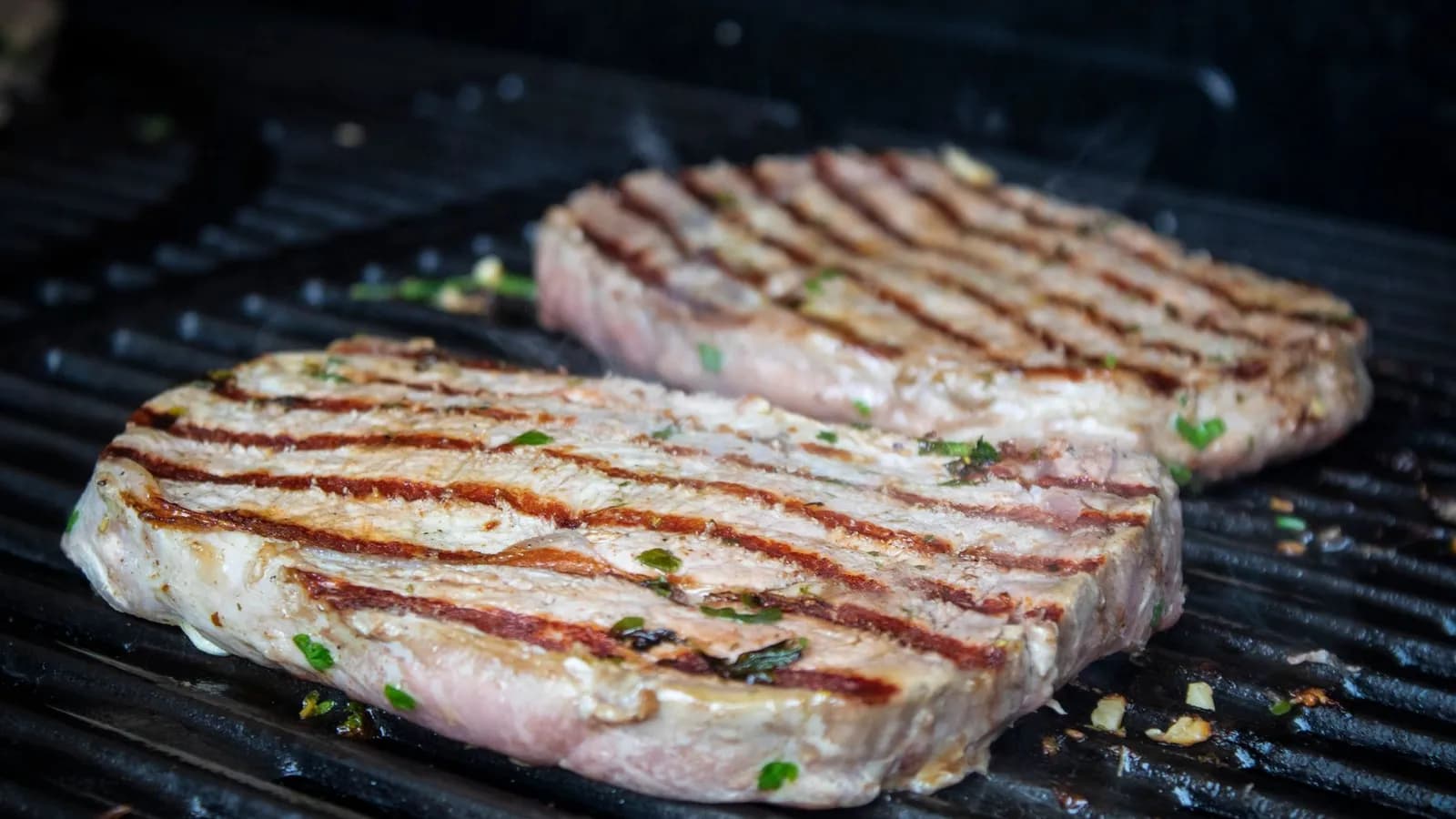
One big step at a time, screen kept on and built-in timers.
- Prep
- 20 min
- Cook
- 60 min
- Servings
- 4 servings
- Temperature
- 115 °C
What time do you want to eat?
Pick a time and we'll tell you when to start.
12:00
Start the prep
12:20
Light the kamado
12:50
Onto the kamado
14:00
Serve
Estimate: it includes lighting and settling the kamado plus a margin for large cuts. If the recipe asks you to marinate or salt ahead, add that time.
Fire setupIndirect, then direct
- Dome
- 115 °C
- Deflector
- Yes
- Grate
- Standard height
- Bottom vent
- A crack
- Top vent
- A crack
- Fuel
- White quebracho charcoal up to the fire ring
- Setup
- ConvEGGtor for the indirect phase, removed to sear
Temperature curve
1:37 h from lighting
Kamado domeInside the meat (probe)
| # | From | Phase | Dome | Internal |
|---|---|---|---|---|
| 1 | 0:00 | Light the charcoalConvEGGtor legs up, 110-120 °C and clean smoke | 20 → 115 °C | no probe |
| 2 | 0:30 | CookFat side up; pull at 55-57 °C in the thickest part (35-50 min) | 115 → 118 °C | 18 → 56 °C |
| 3 | 1:12 | Take outTent with foil and take out the grate and ConvEGGtor | 118 → 100 °C | 56 °C |
| 4 | 1:20 | Raise the heatVents fully open to 250-275 °C; pat the surface dry | 100 → 260 °C | 56 → 57 °C |
| 5 | 1:28 | SearBurp; 3-4 min in all, pull at 63-65 °C | 260 → 255 °C | 57 → 64 °C |
| 6 | 1:32 | RestMortar rub on at once and 5 min under loose foil | 255 → 150 °C | 64 → 66 °C |
| 7 | 1:37 | Serve | off | no probe |
0:00 is the moment you light the charcoal. Internal temperatures are the ones the recipe gives; without a probe, go by the times. Turn these times into clock times with the planner
For this recipe
Ingredients
- whole presa ibérica, acorn-fed (bellota) or free-range (cebo de campo), 600-800 g1
- coarse salt10 g
- pimentón de la Vera (one sweet, one bittersweet)2 tsp
- whole cumin seeds1 tsp
- garlic cloves2
- black peppercorns0.5 tsp
- dried oregano1 tsp
- extra virgin olive oil4 tbsp
- sherry vinegar1 tbsp
- chopped fresh parsley and salt flakes, to serve1 handful
Another cut
Got a different cut? Here is how the recipe changes
For 4 people the recipe uses 1.25 kg (in 2 pieces) of Ibérico presa: reverse sear at 115 °C, 53 min plus 15 min rest. If the shop had something else:
- Pork loin (roast)Buy 1.25 kg
- Fire
- Indirect · 180 °C
- Time
- 1 h 9 min
- Rest
- 15 min
Light 15 min earlier
No reverse sear: an indirect roast. Dome at 180 °C and pull at 63 °C in the centre. It is leaner than presa: rest it loosely covered with foil.
- Pork collar (neck)Buy 1.25 kg
- Fire
- Indirect · 160 °C
- Time
- 2 h 5 min
- Rest
- 15 min
Light 1 h 30 min earlier
Same marbling, more hours. Indirect at 160 °C; for tender slices take the centre to 85 °C, though it is safe from 63 °C. The final sear is optional.
- Picanha (rump cap)Buy 1.25 kg
- Fire
- Reverse sear · 160 °C
- Time
- 40 min
- Rest
- 10 min
Light 20 min later
Beef, same reverse sear. Dome at 160 °C, pull at 46-49 °C and sear to 52 °C in the centre. Slice against the grain.
Times are a guide, based on the How much to buy figures; follow the recipe first. Full fire plan for 4 people: Pork loin (roast), Pork collar (neck), Picanha (rump cap).
Allergens
- Sulphites
Based on the recipe's ingredients. Always check the label of every product you buy.
The gear for this recipe
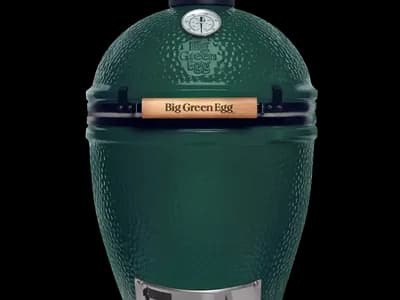
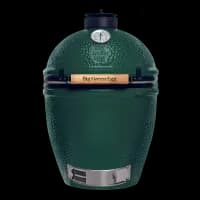 Big Green Egg LargeIt is the kamado I cook this presa on, so I am describing what I see on my own patio: the Large has a 46 cm grate, ample room for an 800 g presa with free grate around it to move it aside if one side is browning too fast. What matters in a reverse-sear is that the same appliance does two things in a row: hold 110-120 °C with the deflector in for forty minutes, then climb to 250-275 °C as soon as you take it out and open the vents. The Egg's thick ceramic and two vents allow that without adding charcoal. The technique works just as well on any ceramic kamado of similar size; what changes is the deflector and the climb times.
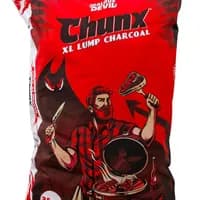 Jealous Devil 100% White Quebracho lump charcoal 15.8 kgWhite quebracho is a very dense wood and its charcoal, in large lumps, burns slowly with little flame, which is what a reverse-sear asks for: in the indirect phase, with the vents nearly closed, a light charcoal would go out or give temperature spikes; a charcoal as dense as Jealous Devil's should hold a compact bed and reach the 250 °C sear with live coals, no top-up needed. The 15.8 kg bag is large for someone who cooks one presa a month, and makes sense for anyone lighting the kamado every weekend. It is a resin-free hardwood, so it adds no resinous smoke to compete with the pimentón de la Vera in the rub.
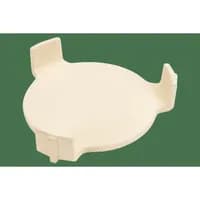 Big Green Egg ConvEGGtor plate setter (Large)It is the official deflector for the Egg Large and sits in its fire ring without adapters, something worth checking with any generic deflector. Legs up, it supports the standard grate and turns the fire into a convection oven: it blocks direct radiant heat and lets only hot air through, which is what keeps the presa at 110-120 °C without the underside toasting ahead of time. It is ceramic, so it stores heat and has to come out with gloves for the searing phase. For other kamados, the maker's own deflector does the same job; the ConvEGGtor is not interchangeable.
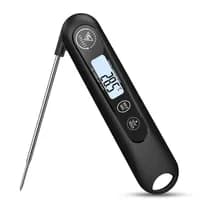 DOQAUS instant-read thermometer, folding probe, 3-second readThe presa is too thin for a wired leave-in probe: the tip would poke out the far side and read hot air. A folding instant-read like the DOQAUS is the right tool: it goes in from the side, the manufacturer quotes a 3-second reading, and the kamado lid is open for the shortest possible time. It is used at 30 minutes into the indirect phase and then every 5-8, and once more after the sear to confirm the 63-65 °C, which is where a three-degree difference changes the dish. It does not stay inside the kamado with the lid shut: it is not built for that, and it is the accessory used most often in this recipe.
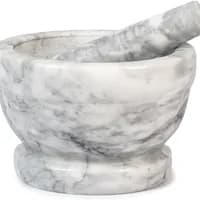 H&H Mortaio: 18 cm white marble mortar with pestleThe rub in this recipe is made by pounding, not blending: the garlic and the whole cumin have to break down to a paste so the paprika and oil can bind them. An 18 cm marble mortar like the H&H has the weight and the rough surface that calls for; light ceramic ones skate across the worktop and the seeds jump out. The diameter is more than enough for the quantities for one presa and falls short if you want to make romesco for eight. It cleans with hot water and a brush, no soap. It is the tool that turns the rub into a paste that clings to hot meat instead of sliding off.
Method
- 01
Salt an hour ahead
Take the presa out of the fridge an hour ahead, pat it dry with kitchen paper and salt both sides with the coarse salt. Leave it uncovered on a rack: the salt dissolves, draws back in and the surface dries, which is what later lets the sear brown instead of steam. Do not trim the outer fat; it renders during the indirect phase and protects the meat.
- 02
Light the Egg for indirect
Fill the firebox of the Big Green Egg Large with Jealous Devil white quebracho charcoal up to the line where the firebox meets the fire ring, no higher, and light it in a single spot. Once the flame has caught, fit the ConvEGGtor legs up, the grate on top, and close the dome. Bottom vent open a finger's width and chimney barely open until it settles at 110-120 °C; wait for the smoke to run clean before the meat goes in.
- 03
Make the rub in the mortar
Peel the garlic and pound it in the mortar with the cumin, the pepper and a pinch of salt until you have a paste; a heavy marble mortar like the 18 cm H&H keeps the seeds inside rather than spitting them out. Add the paprika and the oregano, and bind with the oil and the sherry vinegar in a thin stream. Set it aside at room temperature: it goes on at the end, after the sear, never before.
- 04
Indirect cook to 55-57 °C
Set the presa in the centre of the grate, fat side up, and close the dome. At 110-120 °C a 700 g piece takes between 35 and 50 minutes. At 30 minutes open up, probe from the side towards the centre with the DOQAUS instant-read thermometer, read and close straight away; repeat every 5-8 minutes. Move it to a board as soon as it reads 55-57 °C at the thickest point.
- 05
Remove the deflector and climb to 250 °C
Tent the presa loosely with foil. Wearing barbecue gloves, lift out the grate and the ConvEGGtor, put the grate back and open the bottom vent and the chimney fully. While the dome of the Egg climbs to 250-275 °C on the charcoal already lit, pat the surface of the presa dry with kitchen paper: any moisture steals heat from the sear and delays the crust.
- 06
Sear with burping
Before opening above 250 °C, burp the lid: lift it five centimetres, wait about five seconds and open fully. Presa on the grate, close, 60-90 seconds per side, plus a short second turn of 30-45 seconds per side: 3-4 minutes in total. Probe with the DOQAUS: between 63 and 65 °C it is at the pink point I choose for ibérico. If you prefer it well done, do not stretch the sear: pull the presa from the indirect phase at 63-65 °C and sear exactly the same; it will reach 71 °C.
- 07
Spread the rub and rest
Move the presa to the board and, with the meat still sizzling, coat both sides with the rub from the mortar using the back of a spoon. The residual heat melts the oil and opens up the paprika without toasting it, which is what would turn it bitter. Cover loosely with foil and rest five minutes: the internal temperature climbs a degree or two and the juices settle.
- 08
Slice across the grain
Look at the direction of the fibres, which in a presa run diagonally across the piece, and cut perpendicular to them in one-centimetre slices with a long, sharp knife. The centre should be pink and moist, not red or grey. Serve on the same board, with whatever rub has run off spooned over, a few salt flakes and the chopped parsley.
About this recipe
Presa ibérica is the cut I ask for when I want pork served pink, no argument. It comes from the head of the loin (cabecera del lomo), right next to the shoulder, weighs between 600 and 800 g and is so marbled that it behaves more like a rib-eye than a loin. So I treat it like a rib-eye: reverse-sear on my Big Green Egg Large, indirect and slow first, then a short sear over the coals. No sweet glazes as on the ibérico tenderloin and no mustard crust as on the loin: here the paprika rub is in charge, and it goes on at the end.
Pink at 63 °C: a choice, not an oversight
White pork goes to 71-75 °C, and that is where this site stays for neck, loin or shashlik. Acorn-fed (bellota) or free-range (cebo de campo) presa ibérica is another matter: marbled fat, a hard-working muscle and a level of traceability the rest of the pig rarely has. With that piece, pulling it at 63-65 °C in the centre is a kitchen decision, and I say it out loud: pink, juicy, the fat rendered and none of the dry texture that sets in past 70. If pork in your house is eaten well done, the same recipe works pulled from the indirect phase at 63-65 °C and seared the same way, to 71 °C; you lose a little juice and nothing else. What does not work is judging doneness by eye without a thermometer. The temperature chart lists both thresholds.
Indirect over the ConvEGGtor, and why 115 °C
Reverse-sear flips the usual order: indirect cooking first, searing second. On the Egg that means fitting the ConvEGGtor legs up, the grate on top, and settling the dome between 110 and 120 °C. At that temperature heat travels in slowly and the gap between the edge and the centre of the presa is minimal, so when the centre reads 56 °C the whole piece is at very nearly the same point. A ceramic plate setter like the ConvEGGtor does that job because it blocks the radiant heat of the coals and lets only hot air through. With a dense charcoal such as Jealous Devil's white quebracho, in large lumps that burn slowly, the bed does not run away during the long phase and is still alive when it is time to climb to 250 °C. The presa is thin, 3 to 4 cm at its thickest, and a wired leave-in probe has nowhere to sit without poking out the far side; an instant-read thermometer with a folding probe like the DOQAUS is the better fit: open, probe from the side towards the centre, read in the three seconds the manufacturer quotes, and close. It does not stay inside with the lid shut.
Searing with burping, rub at the end
When the centre reads 55-57 °C, the presa comes out onto a board and the Egg changes role. Out comes the ConvEGGtor with barbecue gloves, bottom vent and chimney fully open, and the dome climbs to 250-275 °C. Opening the lid at that temperature, on my Egg I always burp it: lift five centimetres, wait about five seconds and open fully, so oxygen does not rush in onto a hungry fire; the temperature troubleshooting guide explains flashback. Sear 60 to 90 seconds per side, plus a short second turn, and the presa goes from 57 to 63-65 °C in three or four minutes. You measure it, you do not calculate it.
Pimentón de la Vera carries the pepper's own sugars and burns over direct heat: a rub applied before the sear ends up bitter and black. That is why the mortar comes in at the end, not before. In an 18 cm marble one like the H&H, the heavy pestle crushes garlic, whole cumin and salt to a paste without the seeds jumping out; then in go the paprika, the oregano, the oil and a thread of sherry vinegar. It is spread over the presa fresh from the sear and still hot: the residual heat wakes the aromas without toasting them. Five minutes' rest, slice across the grain in one-centimetre slices, and the pink juice stays in the meat. If you want to know what this cut is called outside Spain, the cuts guide places it.
In 30 seconds
Presa ibérica of 600-800 g, salted an hour ahead. Indirect at 110-120 °C over the ConvEGGtor to 55-57 °C in the centre (35-50 min), rest, deflector out, dome to 250-275 °C with burping, sear 60-90 s per side to 63-65 °C (the point chosen for ibérico; 71 °C if you want it well done). Paprika, garlic and cumin rub made in a mortar, spread on at the end. Rest 5 min and slice across the grain.
Will it fit your kamado?
Small
33-40 cm · Joe Jr, MiniMax
Fits
A 600-800 g presa fits easily; less charcoal is enough.
Medium
46-51 cm · Classic, Large
Fits
This is the recipe's size; probably two presas fit.
Large
56-61 cm · Big Joe, XL
Fits
Room to spare; probably three or four presas at once.
What to serve with it
Sides
- Chargrilled Padrón peppers
- Chargrilled potatoes with aioli
- Wine
- Ribera del Duero or Ribera del Guadiana crianza
- Beer
- Toasted lager or amber ale
- Alcohol-free
- Rosemary lemonade or orange soda
Leftovers and storage
- In the fridge
- Cool within 2 hours; 3-4 days in the fridge in an airtight container.
- Freezing
- Up to 2-3 months, though it loses juiciness; thaw in the fridge.
- Reheating
- Cold in thin slices, or in a covered pan with a splash of stock over medium heat to 74 °C in the centre.
- Using them up
- Presa sandwich with peppers, or tacos with pickled onion.
Cool and refrigerate within 2 hours. When in doubt, throw it out.
Leftover embers
You still have embers: what to do with the leftover heat
For 1 h at 115 °C in a classic kamado you load about 800 g of charcoal and burn 200 g: when you serve, about 590 g of live embers remain. Before you shut the vents, that is still enough for:
Without touching the vents
115 °Ca short smoke
4 h 10 minof embers
- Cherry-Smoked Baby Back Ribs on the Kamado, 2-1-1 Method4 h · 115 °C
- Hot-Smoked Whole Mackerel on the Kamado45 min · 120 °C
No recipe needed
- Coarse salt on a tray, with a wood chunk: smoked salt for months (1-2 h)
- Almonds or walnuts on a rack (45 min)
- Whole heads of garlic, for spreading (1 h)
Opening the vents halfway
140-200 °Cdessert while you eat
1 h 55 minof embers
- Red Wine Poached Pears in an Enamelled Dutch Oven on the Kamado, with Cinnamon and Orange1 h 30 min · 160 °C
- Smoked Loaded Nachos on the Kamado12 min · 185 °C
- Brioche Burger Buns on the Kamado18 min · 190 °C
No recipe needed
- Yesterday's bread with oil and garlic, on the grate (10 min)
- Corn cobs in their husks (30 min)
- Whole apples with a slit in the skin (45 min)
Before opening the lid, crack it open for a few seconds first; if you raise the heat, stir the ash so the coals can breathe. And if you are not going to use them: once the food is out, close the bottom and top vents. The charcoal that does not burn (about 590 g) can be used next time. Different size of kamado? Work out your load for 1 h 30 min of fire, lighting included.
Editor's tips
- The 63-65 °C is a choice for acorn-fed or free-range presa ibérica with a clear origin; with presa from white pork or of doubtful provenance, take the piece to 71 °C without hesitation: you lose a little juice, not the recipe.
- Do not try to leave a wired probe in place: the presa measures 3-4 cm at its thickest and the tip would poke out the far side, reading hot air. Go in from the side with the instant-read thermometer and take your hand away; the DOQAUS does not stay inside with the lid shut.
- If the presa comes vacuum-packed, open it the day before and leave it uncovered in the fridge on a rack: a dry surface sears better and the packaged smell disperses.
- The rub takes variations without losing its point: half a teaspoon of hot paprika instead of bittersweet, or lemon zest added at the end. What does not change is the timing: always after the sear, never over direct heat.
Gear for this recipe
As an Amazon Associate, mikamado.es earns from qualifying purchases. At no extra cost to you.
Big Green Egg Large
It is the kamado I cook this presa on, so I am describing what I see on my own patio: the Large has a 46 cm grate, ample room for an 800 g presa with free grate around it to move it aside if one side is browning too fast. What matters in a reverse-sear is that the same appliance does two things in a row: hold 110-120 °C with the deflector in for forty minutes, then climb to 250-275 °C as soon as you take it out and open the vents. The Egg's thick ceramic and two vents allow that without adding charcoal. The technique works just as well on any ceramic kamado of similar size; what changes is the deflector and the climb times.
€2,099

Jealous Devil 100% White Quebracho lump charcoal 15.8 kg
White quebracho is a very dense wood and its charcoal, in large lumps, burns slowly with little flame, which is what a reverse-sear asks for: in the indirect phase, with the vents nearly closed, a light charcoal would go out or give temperature spikes; a charcoal as dense as Jealous Devil's should hold a compact bed and reach the 250 °C sear with live coals, no top-up needed. The 15.8 kg bag is large for someone who cooks one presa a month, and makes sense for anyone lighting the kamado every weekend. It is a resin-free hardwood, so it adds no resinous smoke to compete with the pimentón de la Vera in the rub.
€207

Big Green Egg ConvEGGtor plate setter (Large)
It is the official deflector for the Egg Large and sits in its fire ring without adapters, something worth checking with any generic deflector. Legs up, it supports the standard grate and turns the fire into a convection oven: it blocks direct radiant heat and lets only hot air through, which is what keeps the presa at 110-120 °C without the underside toasting ahead of time. It is ceramic, so it stores heat and has to come out with gloves for the searing phase. For other kamados, the maker's own deflector does the same job; the ConvEGGtor is not interchangeable.
€85
DOQAUS instant-read thermometer, folding probe, 3-second read
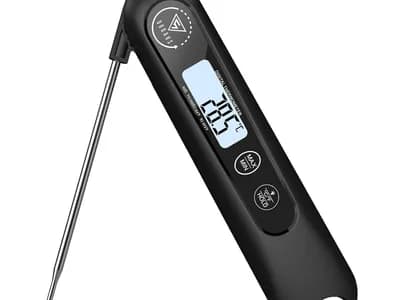
The presa is too thin for a wired leave-in probe: the tip would poke out the far side and read hot air. A folding instant-read like the DOQAUS is the right tool: it goes in from the side, the manufacturer quotes a 3-second reading, and the kamado lid is open for the shortest possible time. It is used at 30 minutes into the indirect phase and then every 5-8, and once more after the sear to confirm the 63-65 °C, which is where a three-degree difference changes the dish. It does not stay inside the kamado with the lid shut: it is not built for that, and it is the accessory used most often in this recipe.
€6
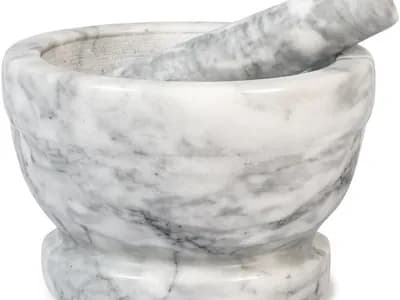
H&H Mortaio: 18 cm white marble mortar with pestle
The rub in this recipe is made by pounding, not blending: the garlic and the whole cumin have to break down to a paste so the paprika and oil can bind them. An 18 cm marble mortar like the H&H has the weight and the rough surface that calls for; light ceramic ones skate across the worktop and the seeds jump out. The diameter is more than enough for the quantities for one presa and falls short if you want to make romesco for eight. It cleans with hot water and a brush, no soap. It is the tool that turns the rub into a paste that clings to hot meat instead of sliding off.
€33
Have you made it?
Tell us how it turned out on your kamado. We review every rating before publishing it.
No published ratings yet. Be the first!
FAQ
What internal temperature should presa ibérica be served at?
It depends on the piece and on who is eating. With good-quality presa ibérica, between 63 and 65 °C in the centre the meat is pink, juicy and its marbled fat has rendered; that is this recipe's choice and it should be made knowingly. The classic reference for pork is 71-75 °C and it still holds: the presa takes that point thanks to its marbling, though it loses some of the juice. Always measure in the centre with a thermometer, never by eye.
Which part of the pig is presa ibérica?
The presa is a muscle at the head of the loin, sitting between the shoulder and the start of the loin proper, around 600-800 g apiece, two per pig. It is sold whole, fan-shaped and with very visible marbling that sets it apart from the loin and the tenderloin. Outside Spain it comes close to "pork collar" or Italian "coppa", but does not match either exactly: it is a cut with a name of its own at the Spanish butcher's.
How long does presa ibérica take on the kamado with reverse-sear?
Allow an hour to an hour and a quarter from the moment the meat goes in: 35 to 50 minutes indirect at 110-120 °C to 55-57 °C in the centre, however long the kamado takes to climb to 250 °C without the deflector, and 3-4 minutes of direct searing. Plus the five minutes' rest with the rub. The exact time is set by the thermometer, not the clock: a 600 g presa and an 800 g one do not finish together.
Why does the paprika rub go on after searing and not before?
Because pimentón de la Vera carries the pepper's own sugars, which burn over direct heat and leave a bitter undertone and a black crust. Applied to meat fresh from the sear, the residual heat wakes it up without toasting it. If you would rather marinate beforehand, marinate the presa with garlic, cumin, salt and oil and no paprika, and add the paprika at the end all the same, when the meat comes off the grate.
Can you cook presa ibérica directly over the coals without reverse-sear?
Yes, and it comes out well if the piece is thin and even: direct heat at 220-250 °C, turning every 2-3 minutes, around 12-15 minutes in total. The problem is the presa's uneven thickness, with its fan shape: the thin end reaches 70 °C while the thick end is still at 55. Reverse-sear evens out that difference in the indirect phase and leaves the sear for the crust alone.
Can I make this recipe with a different cut instead of Ibérico presa?
Picanha keeps the reverse sear, with a hotter dome and a lower finish. Pork loin and collar switch to an indirect roast; collar takes more doneness and can get a final sear if you want a crust. The probe decides, not the clock.
What do I do with the embers left after making Reverse-Sear Presa Ibérica on the Kamado, Pink at 63 °C?
After 1 h at 115 °C in a classic kamado about 590 g of live embers remain: 4 h 10 min more at 115 °C without touching the vents or 1 h 55 min at 140-200 °C opening the vents. If you are not going to use them, close both vents and keep the charcoal for next time.
More kamado recipes
KEEP READING
Go deeper on this dish
- Recommended kamado
Big Green Egg Large
It is the kamado I cook this presa on, so I am describing what I see on my own patio: the Large has a 46 cm grate, ample room for an 800 g presa with free grate around it to move it aside if one side is browning too fast. What matters in a reverse-sear is that the same appliance does two things in a row: hold 110-120 °C with the deflector in for forty minutes, then climb to 250-275 °C as soon as you take it out and open the vents. The Egg's thick ceramic and two vents allow that without adding charcoal. The technique works just as well on any ceramic kamado of similar size; what changes is the deflector and the climb times.
- Editorial guide
How to light a kamado: the step-by-step method
No petrol, no weird tablets and no 45-minute waits. The cone method, airflow control and the mistakes that prevent 80% of the frustration.
- Glossary term
Heat deflector
Ceramic plate placed between the coals and the grate to turn direct fire into indirect cooking.
- Related comparison
big green egg large vs kamado joe classic iii
The classic kamado matchup: the Big Green Egg Large, the indestructible pioneer with the widest accessory network, agai…